Montana went dry three years before the rest of America. In 1916, the state passed its own prohibition law, banning the sale and manufacture of alcohol well before the Eighteenth Amendment made it a national affair in 1920. The state's temperance movement, led by powerful mining-town reformers and progressive politicians, succeeded where many other states had stalled. But passing the law was one thing. Enforcing it across 147,000 square miles of mountains, prairie, and wilderness was something else entirely.
The Canadian Border: 550 Miles of Opportunity
Montana shares 550 miles of border with Canada. In the 1920s, much of that border was unfenced, unpatrolled, and utterly wild. The Canadian provinces of Alberta, Saskatchewan, and British Columbia had their own complicated relationship with alcohol -- legal production continued in Canada even as American prohibition created an insatiable market to the south. The result was a smuggling corridor that stretched the entire width of the state.
Canadian distillers and brewers were only too happy to supply the demand. Whiskey, beer, and spirits flowed south across the border by every conceivable method. Bootleggers used automobiles, horse-drawn wagons, pack mules, and even sleds in the winter. They crossed at remote prairie locations where the only thing between them and the Canadian side was a barbed wire fence and a few hundred yards of grassland. In the mountainous west, they used pack trails through Glacier Park and the Flathead region, routes so remote that enforcement was virtually impossible.
The border crossings were organized with military precision. Scouts watched the roads for revenue agents. Relay teams passed cargo from one vehicle to another at predetermined points. Coded signals -- a lantern in a window, a specific pattern of honks -- coordinated movements across the line. Some operations used ranches on both sides of the border as staging areas, storing liquor in barns and root cellars until it could be moved south to distribution points.
The Hi-Line Corridor
The Great Northern Railway's Hi-Line -- the railroad that runs east-west across the top of Montana, through towns like Havre, Glasgow, Malta, and Wolf Point -- became the backbone of the state's bootlegging network. The railroad towns were perfectly positioned to receive Canadian liquor coming south and distribute it to the rest of the state.
Havre, sitting just thirty miles south of the Canadian border, became the bootlegging capital of Montana. The town's location made it a natural hub, but it was what lay beneath the town that made it legendary. When a fire destroyed much of downtown Havre in 1904, businesses rebuilt at street level but kept the underground spaces. During Prohibition, these basements and tunnels became a hidden city -- bars, gambling dens, and opium joints operated beneath the feet of the respectable citizens walking above.
Havre's underground was not unique. Many Hi-Line towns had similar arrangements, albeit on a smaller scale. The culture of the region -- ranchers, railroad workers, miners -- was not inclined toward temperance. These were working men who considered a drink at the end of the day a fundamental right, and they were not going to let a law passed by politicians in Helena or Washington take it away.
The railroad itself was both a tool of smuggling and a vector of enforcement. Bootleggers hid liquor in freight cars, in livestock shipments, and in hollowed-out timber loads. Revenue agents rode the same trains, inspecting cargo and watching for suspicious activity. It was a rolling cat-and-mouse game played out across hundreds of miles of empty prairie.
Butte: The City That Never Went Dry
If the Hi-Line was the pipeline, Butte was the reservoir. Montana's great copper mining city, which at its peak was one of the largest cities west of the Mississippi, had a drinking culture that prohibition could not touch. Butte was a city built on hard labor in dangerous mines, populated by Irish, Cornish, Finnish, Italian, Serbian, and Chinese immigrants, and governed by an ethic that valued personal freedom above almost everything else.
When prohibition hit, Butte's saloons did not close. They moved. Some went underground -- literally, into basements and mine tunnels. Others simply hung curtains over their windows and continued operating as "soft drink parlors" that served everything but soft drinks. The city's political establishment, deeply intertwined with the Anaconda Copper Mining Company, had little interest in enforcing temperance laws that would upset the workforce. Federal agents who ventured into Butte found a city that was openly, cheerfully, and almost unanimously defiant.
Butte's speakeasies were not hidden, shameful places. They were the social heart of the city. Miners finished their shifts, washed off the copper dust, and headed to their favorite basement bar as naturally as they headed home for dinner. The bootleggers who supplied these establishments were not considered criminals. They were businessmen providing an essential service. Some of Butte's most prominent citizens were openly involved in the liquor trade, and the community protected them.
The Rancher's Still
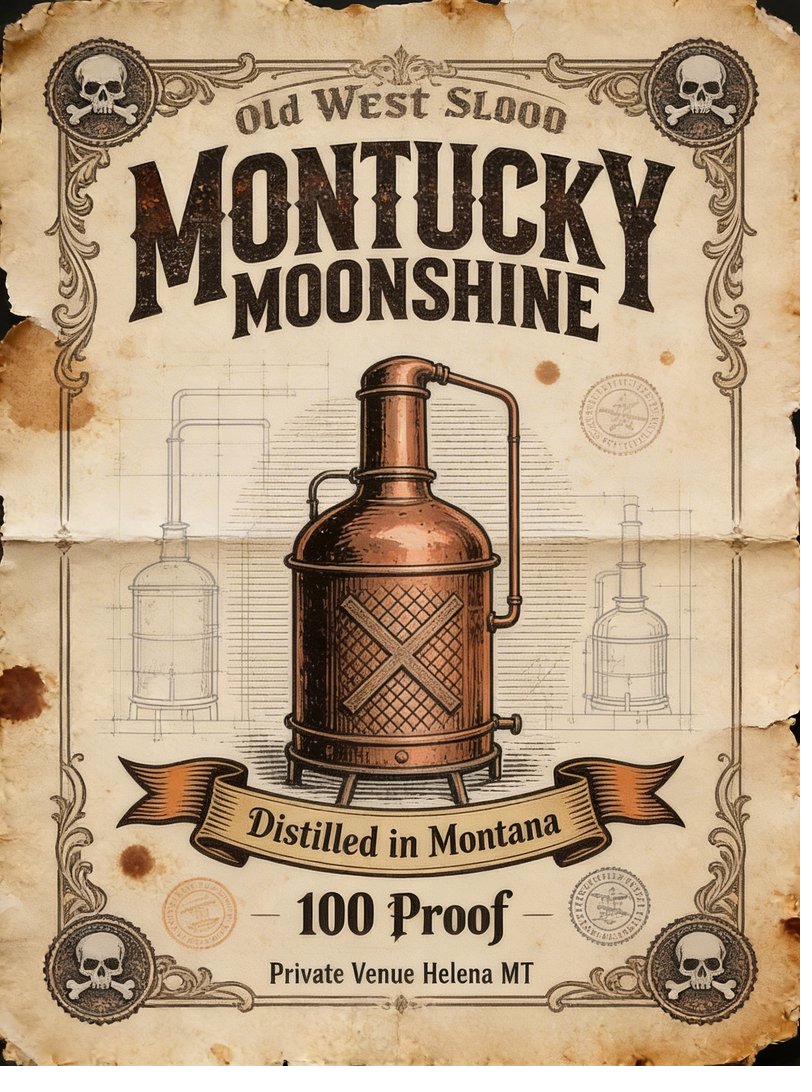
While the border smuggling and urban speakeasies grabbed the headlines, there was another, quieter form of prohibition resistance happening across rural Montana. Ranchers and homesteaders, isolated by vast distances from both the law and the liquor supply chain, simply made their own. Small copper stills operated in ranch outbuildings, in root cellars, and in the coulees and gulches that crease Montana's landscape.
These were not large commercial operations. They were family stills, producing enough whiskey for personal use and perhaps a little extra to share with neighbors or trade at the general store. The tradition of home distilling in Montana predated prohibition and continued long after it ended. In remote areas, it was simply a fact of life -- as unremarkable as growing a garden or curing meat.
The isolation that made enforcement difficult also made it unnecessary. A rancher running a small still fifty miles from the nearest town was not a threat to public order. He was a self-sufficient citizen exercising what he considered a basic right. Revenue agents, few in number and vast in territory, generally focused their efforts on the larger smuggling operations and urban speakeasies, leaving the ranch stills alone.
When the Dam Broke
When national prohibition ended in December 1933, Montana was more than ready. The state's experience with its own earlier prohibition had been a thorough demonstration that you cannot legislate away a culture. Montanans had spent seventeen years -- three under state prohibition, thirteen under the federal version -- developing creative, elaborate, and occasionally hilarious methods of keeping the drinks flowing. The repeal was less a change in behavior than a change in paperwork.
The legacy of Montana's prohibition era goes deeper than colorful stories about speakeasies and smugglers. It reinforced a core element of Montana's identity: the conviction that the government's reach should stop somewhere short of a person's private choices. That attitude did not start with prohibition and it did not end there. It runs through the state's approach to land use, gun rights, speed limits (Montana famously had no daytime speed limit until 1999), and dozens of other issues where personal freedom bumps up against government regulation.
The Trail Lives On
Today, you can still trace the bootlegger trail across Montana. Havre's underground tours take visitors through the tunnels and basements where prohibition-era businesses operated. Butte's historic uptown district is still lined with buildings that housed speakeasies. Along the Hi-Line, local museums preserve the stories and artifacts of the smuggling era. And on remote ranches, families still tell stories about grandparents and great-grandparents who kept a still running through the dry years.
Montucky Moonshine carries forward the spirit of that trail. Not the lawbreaking -- we are legal, licensed, and proud of it. But the independence. The refusal to let someone else define what Montana should drink. The belief that great spirits come from great people working with great ingredients in a place that values doing things the right way, even when no one is watching. Especially when no one is watching.
The bootlegger trail runs through Montana's history. But the spirit it represents -- stubborn, independent, unapologetically authentic -- runs through Montana's present. And its future.
Walk the trail
Explore our handcrafted collection -- born from Montana grit and moonshine heritage.
Shop the Collection